
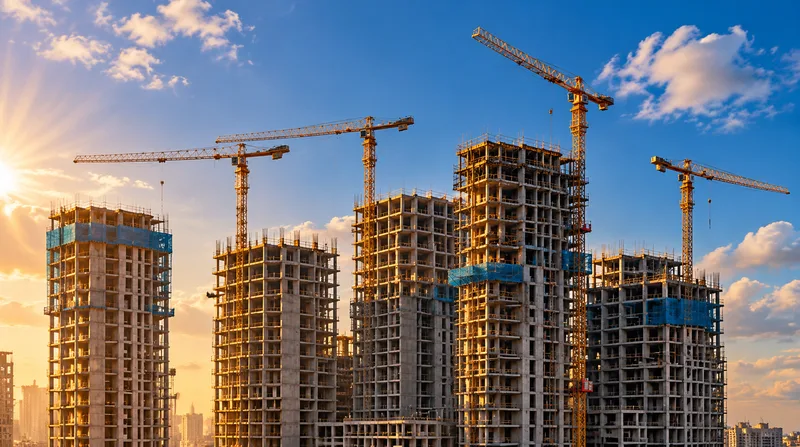
Initiative: gradual reduction in the cost of a square meter
The development of measures aimed at reducing the cost per square meter in new buildings is being discussed at the legislative level. The emphasis is on phasing: decisions are prepared jointly with the government and are focused primarily on projects with budget financing, while the quality of construction must remain consistently high.
Where market participants see reserves
The development community as a whole supports the goal of increasing housing affordability and eliminating excess costs in the industry. The main directions that developers name are as follows:
reduction of approval and construction periods;
optimization of costs for connecting to utility networks;
transparent conditions for land plots and land allocation;
reduction in the cost of project financing;
reduction of administrative procedures and creation of a “single window” for infrastructure issues.
According to market participants, such measures can affect the cost of projects and indirectly support the market as a whole, including the premium segment.
The main issue is predictability, not an artificial discount
The key thesis of the developers: what is more important is not the administrative price reduction, but the predictability of costs, the availability of credit resources and the stability of regulatory conditions. This is what makes it possible to more accurately plan projects, maintain quality and formulate a reasonable pricing policy.
Direct price reductions today are limited by the construction financing model itself: the project financing system does not allow developers to dramatically reduce the cost of lots without risking the economics of the project.
Expensive money and demand
A separate factor is the cost of borrowed funds. With high rates on standard mortgage programs, a relatively small proportion of buyers can afford a market loan, which reduces purchasing activity. At the same time, a tight monetary policy is considered by market participants as a forced measure: it curbs inflation and maintains the stability of the national currency, and the key rate is reduced gradually. Its sharp decrease, according to experts, can negate the efforts of the regulator.
Banking component in the price of a meter
One of the main reserves, according to estimates developers lies in the financial plane. The cost of servicing a bank loan in the price per square meter reaches up to 20%, while the median profitability of a developer is 5–10%. That is, the banking component is already comparable to the developer’s margin or exceeds it.
Hence the proposals to revise the cost of money in the project financing model - for example, through subsidizing the rate for projects with social housing or through a more flexible link to the filling of escrow accounts.
What is proposed additionally
Subsidizing developers who actively invest in the development of social infrastructure.
Deferred payments for important urban planning procedures, including change of type permitted use of sites - up to the period of a noticeable reduction in the key rate.
Flexible terms of project financing taking into account the pace of sales, the stage of readiness of the object and regional specifics.
Pilot format: comprehensive measures that are being implemented gradually - first on individual projects, then spreading to mass construction.
Why prices will not drop quickly
The cost of construction continues to rise: materials and equipment become more expensive, logistics and labor costs increase. At the same time, the volume of supply in many regions exceeds demand, which means that developers have limited price maneuver.
Current market benchmarks:
Indicator | Value |
Average price per square meter in the country | about 165 thousand rubles |
Average sell-out of projects at the time of delivery | about 70% |
Median profitability of the developer | 5–10% |
Share of loan servicing costs in the price of a meter | up to 20% |
Sold out at the time of delivery is about 70% - the lowest figure in the last six years. In such a situation, market participants expect price stability rather than a noticeable decline in prices. the coming years.
Support measures: precaution is important
The working scenario is support that comes before serious financial difficulties arise for the project. This will reduce the burden on developers, maintain investment activity and prevent a reduction in construction volumes - and therefore a future supply shortage.
Result
The discussion about reducing the price per square meter is shifting from administrative pressure on the price to working with the cost: timing of approvals, connection to networks, land conditions and cost project financing. It is in these areas that market participants see real reserves. For the buyer, this means that there is no need to expect a sharp reduction in prices - it is more realistic to count on price stabilization and increased market predictability.